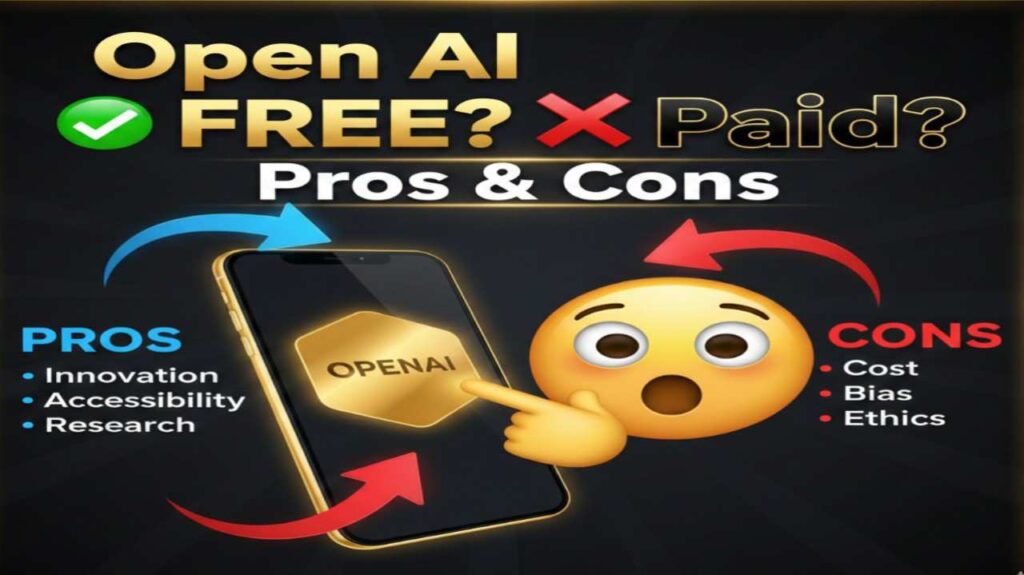
Open AI is a leading artificial intelligence platform that offers advanced models for generating text, images, code, and more through tools like ChatGPT, DALL-E, and Sora. It enables users to create content, automate tasks, and solve complex problems using natural language processing and machine learning, making it a go-to resource for developers, businesses, and everyday users looking to leverage generative AI for practical applications.
Is Open AI Free or Paid?
OpenAI provides a combination of free and paid access to cater to diverse needs. The basic ChatGPT experience is available for free, allowing users to interact with standard models for simple queries and tasks without any cost. For more sophisticated features, such as access to premium models, higher usage limits, and enterprise tools, paid subscriptions are necessary. This structure ensures broad accessibility while offering enhanced performance for professional and high-volume use cases.
Open AI Pricing Details
Open AI pricing revolves around its ChatGPT plans, with tiers ranging from free entry-level access to enterprise solutions. The following table summarizes the key options based on available details:
| Plan Name | Price (Monthly / Yearly) | Main Features | Best For |
|---|---|---|---|
| Free | Free / Free | Access to basic models like GPT-5.2 Instant, limited messages, chat history, standard quality updates | Casual users handling everyday queries and light tasks |
| Go | $10 / $120 | Expanded access to GPT-5.2, more messages and uploads, longer memory, potential ads | Users needing slightly more capacity for regular chatting without heavy demands |
| Plus | $20 / $240 | Advanced reasoning models, expanded limits on messages and image generation, custom GPTs, early feature access | Individuals seeking boosted productivity and creative tools |
| Pro | $200 / $2,400 | Unlimited access to pro models like GPT-5.2 Pro, maximum research and agent capabilities, expanded video generation | Power users requiring top-tier AI for intensive research and development |
| Business | $30 per user / $360 per user | Unlimited messages, integrations with apps like Slack, secure workspace, admin controls, no data training | Growing teams focused on collaboration, security, and business workflows |
| Enterprise | Custom / Custom | Everything in Business plus enterprise security, custom retention, 24/7 support, volume discounts | Large organizations needing scalable, secure AI with tailored support |
Also Read-Vozo AI Shorts Generator Free, Alternative, Pricing, Pros and Cons
Open AI Alternatives
While Open AI sets a high standard in generative AI, several alternatives provide comparable or specialized features, often with different pricing models or focuses on ethics and integration. Here’s a comparison of notable options:
| Alternative Tool Name | Free or Paid | Key Feature | How it Compares to Open AI |
|---|---|---|---|
| Anthropic Claude | Both (free limited, paid Pro) | Ethical AI with strong reasoning and long-context handling | Emphasizes safety and interpretability; more steerable than OpenAI but with stricter content guidelines and potentially higher costs for advanced use |
| Google Gemini | Both (free basic, paid advanced) | Multimodal processing integrating search, images, and code | Better tied to Google’s ecosystem for real-time data; offers similar versatility but may lag in creative text generation compared to OpenAI’s models |
| Microsoft Copilot | Both (free tier, paid enterprise) | Seamless integration with Microsoft 365 apps and Bing search | Stronger for productivity in office environments; comparable in capabilities but relies on OpenAI tech underneath, with added enterprise security |
| xAI Grok | Both (free access via X, paid premium) | Humorous, real-time responses with web integration | More casual and tied to social media; faster for current events but less focused on deep research than OpenAI’s structured outputs |
| Perplexity AI | Both (free basic, paid Pro) | Research-focused with cited sources and follow-up queries | Excels in accurate, sourced answers; a solid alternative for informational tasks where OpenAI might provide more generalized responses |
Open AI Pros and Cons
OpenAI delivers powerful AI capabilities, but it’s essential to evaluate its strengths alongside potential limitations for balanced adoption.
Pros
- Advanced Model Performance: Offers state-of-the-art models like GPT-5.2 for superior reasoning, content creation, and multimodal tasks.
- Versatile Applications: Supports a wide range of uses, from chatbots and coding to image and video generation, enhancing creativity and efficiency.
- Scalable Tiers: Free access for beginners, with paid plans providing unlimited usage and integrations for professional needs.
- Continuous Updates: Regular improvements and early access to new features keep users at the forefront of AI advancements.
- Developer-Friendly API: Easy integration for building custom apps, with tools for fine-tuning and automation.
Cons
- High Costs for Premium Access: Advanced plans like Pro can be expensive, limiting affordability for individual users or small teams.
- Privacy and Data Concerns: Processes user data for personalization, raising issues around security and potential misuse.
- Potential Biases and Inaccuracies: Outputs may reflect training data flaws, requiring verification to avoid errors or biased results.
- Usage Limits on Free Tier: Restrictions on messages and features can hinder extensive testing or heavy reliance.
- Dependency on Cloud Infrastructure: Relies on internet access and OpenAI’s servers, which may experience downtime or rate limiting.