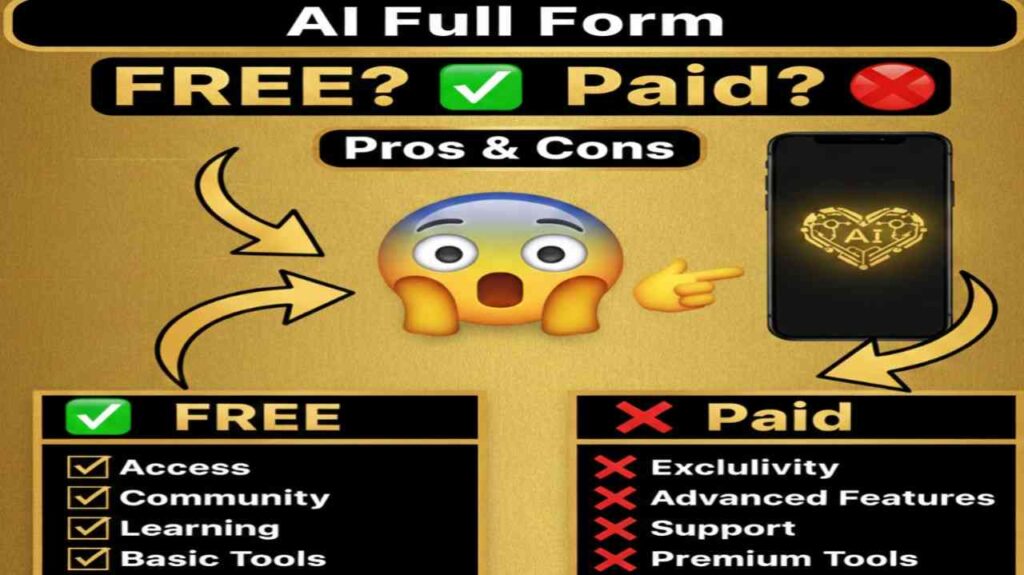
AI full form stands for Artificial Intelligence. It refers to the simulation of human intelligence processes by machines, particularly computer systems. These processes include learning (acquiring information and rules for using it), reasoning (using rules to reach approximate or definite conclusions), and self-correction. In practical terms, AI enables computers to perform tasks that typically require human cognition, such as understanding natural language, recognizing patterns, solving problems, making decisions, and even creating content. From virtual assistants and recommendation engines to autonomous vehicles and medical diagnostics, AI powers much of today’s innovative technology.
Is AI Free or Paid?
The concept behind the AI full form—Artificial Intelligence—is not a product or service with direct pricing; it’s a field of computer science and a set of technologies. However, accessing AI capabilities depends on the tools, platforms, or applications built on it. Most everyday AI experiences (like using chatbots, voice assistants, or basic image recognition) are free through consumer apps and devices. Advanced or enterprise-grade AI solutions—such as custom models, high-volume processing, or specialized APIs—typically require paid subscriptions, cloud credits, or licensing fees from providers like Google, OpenAI, Microsoft, or AWS.
AI Full Form Pricing Details
Since AI full form represents a broad technology domain rather than a single tool, “pricing” applies to popular platforms that deliver AI functionality. Here’s a representative overview of access tiers for leading AI services in 2026:
| Plan Name | Price (Monthly / Yearly) | Main Features | Best For |
|---|---|---|---|
| Free / Basic | $0 | Access to standard models (e.g., GPT-4o mini, Gemini 1.5 Flash), limited daily usage or tokens, core chat/image generation, no commercial rights | Students, casual users, hobbyists exploring AI capabilities |
| Pro / Individual | $15–$25/month ($150–$250/year with discounts) | Higher token limits, access to advanced models (e.g., o1, Claude 3.5), faster responses, priority during peaks, some commercial use | Content creators, developers, small businesses needing reliable daily AI assistance |
| Team / Enterprise | $20–$60+/user/month or custom | Unlimited/high-volume access, team sharing, admin controls, fine-tuning options, enhanced security/compliance, dedicated support | Organizations, agencies, large teams building AI-powered products or workflows |
Also Read-Character Tavern Free, Alternative, Pricing, Pros and Cons
Best AI Alternatives
While AI full form (Artificial Intelligence) is the foundational term, users often seek specific platforms or models that embody AI. Here are strong alternatives across major providers:
| Alternative Tool Name | Free or Paid | Key Feature | How it Compares to AI Full Form |
|---|---|---|---|
| ChatGPT (OpenAI) | Free tier + Paid (~$20/month) | Versatile conversational AI, strong creative and coding support | One of the most popular implementations of AI; excels in broad tasks and has a massive user base, often seen as the default face of modern AI |
| Google Gemini | Free + Paid (~$20/month via Google One) | Multimodal (text, image, video), real-time search grounding | Deep integration with Google services; superior for factual, up-to-date queries and visual understanding compared to some standalone AI tools |
| Claude (Anthropic) | Free tier + Paid (~$20/month) | Exceptional long-context handling, ethical reasoning | Prioritizes safety and detailed analysis; often preferred for complex writing/research tasks where nuance matters more than speed |
| Microsoft Copilot | Free (with account) + Paid enterprise | Tight integration with Office 365, document analysis | Ideal for productivity in Microsoft environments; more work-focused than general-purpose AI experiences |
| Grok (xAI) | Free tier + Paid via X Premium | Real-time knowledge from X platform, witty and uncensored style | More current-event oriented and personality-driven; differs in source grounding and tone from mainstream AI implementations |
AI Pros and Cons
Understanding the strengths and limitations of Artificial Intelligence (AI full form) helps evaluate its real-world value and application.
Pros
- Automates complex tasks: Handles repetitive, data-heavy, or precision-demanding work far faster and more consistently than humans.
- Scales effortlessly: Processes massive volumes of information and learns from new data without proportional increases in cost or time.
- Drives innovation: Powers breakthroughs in healthcare diagnostics, autonomous systems, personalized education, and creative industries.
- Enhances human capabilities: Acts as a powerful assistant for research, writing, coding, analysis, and decision support.
- Continuously improves: Models get smarter over time through updates, larger datasets, and better algorithms.
Cons
- Risk of errors and bias: Can produce hallucinations, perpetuate training data biases, or make flawed decisions without oversight.
- High resource demands: Training and running advanced models require significant computational power, energy, and cost.
- Job displacement concerns: Automates roles in writing, design, customer service, and analysis, raising economic and social questions.
- Privacy and ethical issues: Relies on vast datasets that may include personal information; misuse risks deepfakes, misinformation, or surveillance.
- Lack of true understanding: Excels at pattern matching but lacks genuine comprehension, common sense, or moral reasoning like humans.