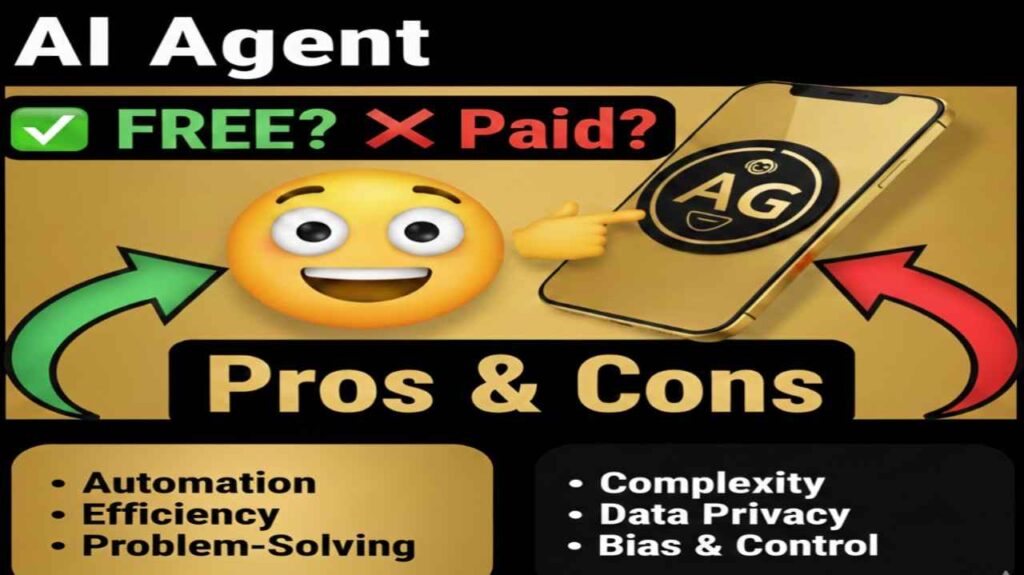
An AI agent is an autonomous artificial intelligence system capable of perceiving its environment, reasoning through complex goals, planning multi-step actions, using external tools or APIs, and executing tasks with minimal human intervention. Unlike traditional chatbots that respond reactively, AI agents operate proactively—handling workflows like research, data analysis, customer support, coding, content creation, or business automation. Powered by large language models (often with orchestration frameworks), AI agents adapt in real time, maintain memory across interactions, and collaborate in multi-agent setups, making them essential for productivity, enterprise efficiency, and next-generation applications in 2026.
Is AI Agent Free or Paid?
AI agent solutions range from completely free open-source frameworks to paid enterprise platforms and hosted services. Many foundational tools and no-code builders offer robust free tiers or open-source code for personal, experimental, or small-scale use. Paid options provide scalability, reliability, governance, priority support, advanced integrations, and higher usage limits—crucial for production deployments, teams, or businesses automating critical processes. Free access dominates for developers and hobbyists building custom agents, while paid plans target organizations needing secure, compliant, and high-performance agentic automation.
AI Agent Pricing Details
Since AI agents encompass frameworks, no-code builders, and enterprise platforms, pricing varies widely—from free open-source to subscription or usage-based models. Here’s a representative overview of popular options in 2026:
| Plan Name | Price (Monthly / Yearly) | Main Features | Best For |
|---|---|---|---|
| Open-Source Frameworks (LangGraph, CrewAI, AutoGen) | $0 / $0 | Full code access, multi-agent orchestration, tool integration, custom logic | Developers, startups, researchers building bespoke agents |
| No-Code Builders Free Tier (Gumloop, Relay.app, n8n) | $0 / $0 | Visual workflow creation, basic agents, limited executions/credits | Non-technical users, small teams prototyping automation |
| Pro / Paid Plans (Gumloop Pro, CrewAI Teams, Lindy Pro) | $20–$99 / ~$200–$1,000 annually | Unlimited agents, higher credits/executions, integrations, team collaboration | Growing businesses, marketers, creators scaling agentic workflows |
| Enterprise Platforms (Microsoft Copilot Studio, Salesforce Agentforce, Kore.ai) | Custom / $500+ or usage-based | Governance, security, enterprise integrations, observability, compliance | Large organizations deploying secure, scalable agents at production level |
Also Read-Skolar AI Free, Alternative, Pricing, Pros and Cons
AI Agent Alternatives
The AI agent ecosystem includes diverse frameworks, no-code builders, and enterprise solutions. Here are strong alternatives with unique strengths:
| Alternative Tool Name | Free or Paid | Key Feature | How it Compares to General AI Agent Solutions |
|---|---|---|---|
| LangGraph (LangChain) | Free (open-source) | Graph-based stateful orchestration, human-in-the-loop | Core framework for controllable agents; more structured and developer-focused than simpler no-code builders |
| CrewAI | Free tier; Paid from ~$99/mo | Role-based multi-agent teams mimicking human collaboration | Excellent for collaborative workflows; easier team-like setup but requires more configuration than some hosted platforms |
| AutoGen (Microsoft) | Free (open-source) | Conversational multi-agent systems, strong scalability | Enterprise-friendly with excellent documentation; great for research but more coding-oriented than visual no-code tools |
| Gumloop | Free tier; Paid from ~$30/mo | No-code agent and automation builder | Highly accessible for non-developers; focuses on simplicity over deep custom logic found in open-source frameworks |
| Lindy | Free plan; Paid upgrades | No-code multi-agent workflows, task automation | Strong for everyday business tasks; user-friendly but less flexible for highly technical or custom agent behaviors |
| Microsoft Copilot Studio | Paid (via Microsoft 365) | Enterprise-grade agents with governance and integrations | Ideal for Microsoft ecosystem users; robust compliance but higher cost and less open than free frameworks |
AI Agent Pros and Cons
AI agents represent a leap toward true autonomy, but they come with complexity and reliability trade-offs.
Pros:
- Enable proactive, multi-step task execution—automating entire workflows like research, support, or data processing without constant supervision.
- Adapt dynamically through reasoning, planning, and tool usage, handling complex, changing scenarios effectively.
- Support multi-agent collaboration where specialized agents work together for sophisticated outcomes.
- Integrate with APIs, databases, and external systems to perform real actions and deliver tangible results.
- Accelerate productivity for both technical (developers) and non-technical users via frameworks and no-code platforms.
Cons:
- Can be unpredictable due to non-deterministic LLM behavior, leading to errors, hallucinations, or off-track executions.
- Require careful design and monitoring to prevent issues like infinite loops, high costs, or security vulnerabilities.
- Steep learning curve for advanced custom agents, especially in open-source frameworks needing coding expertise.
- Higher computational and cost demands compared to simple rule-based automation or basic chat tools.
- Scaling to reliable production often involves paid features, governance tools, and ongoing maintenance.