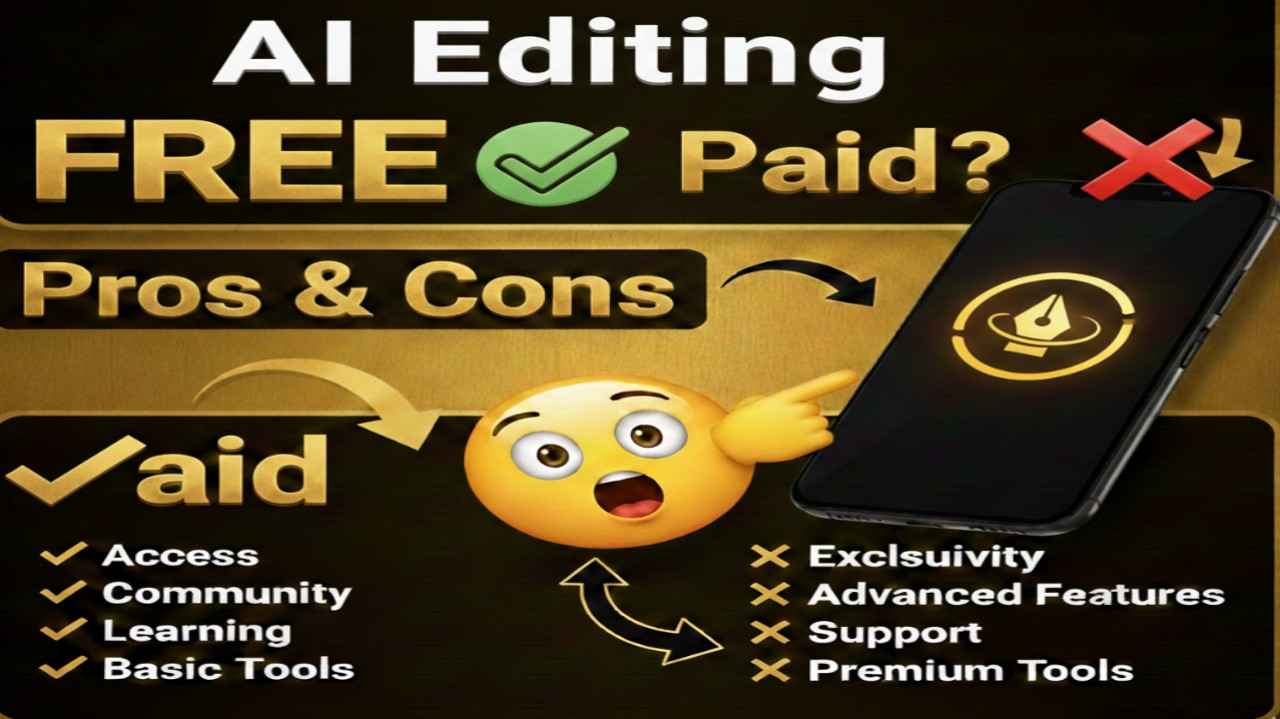
AI editing refers to the use of artificial intelligence-powered software and platforms to enhance, modify, and create photos, videos, text content, or other media. These tools automate complex tasks such as object removal, background changes, color correction, upscaling, noise reduction, video clipping, caption generation, B-roll insertion, eye-contact correction, and script-to-video conversion. By leveraging machine learning models, AI editing delivers faster, more precise results than traditional manual methods, making it invaluable for photographers, videographers, content creators, marketers, and social media professionals who need polished outputs with minimal effort.
Is AI Editing Free or Paid?
AIediting tools generally follow a freemium model. Basic features—like simple enhancements, limited generations, or trial edits—are often free, allowing users to experiment and create initial content without cost. Paid subscriptions unlock professional capabilities such as unlimited processing, high-resolution exports, watermark removal, premium asset libraries, advanced AI models, batch editing, and commercial licensing. This structure suits occasional users on free plans while providing scalable, reliable performance for frequent or professional workflows through paid tiers.
AI Editing Pricing Details
Pricing varies by platform and focus (photo vs. video vs. general content), but popular AI editing tools share similar tiered structures with monthly or annual billing options. Here’s a representative overview based on leading solutions in 2026:
| Plan Name | Price (Monthly / Yearly) | Main Features | Best For |
|---|---|---|---|
| Free / Basic | $0 | Limited credits/generations, standard resolution, watermarked outputs, core enhancements (removal, auto-adjust, basic captions) | Beginners, casual users, or testing AI editing before committing |
| Starter / Pro | $10–$30/month ($100–$300/year with discounts) | Higher limits/credits, no watermarks, 4K+ resolution, advanced tools (generative fill, eye-contact fix, B-roll), faster processing | Individual creators, photographers, small YouTubers needing regular professional edits |
| Business / Enterprise | $50–$150+/month or custom | Unlimited/high-volume processing, team collaboration, API access, premium libraries, priority support, brand kits | Agencies, marketing teams, or businesses requiring scalable, collaborative AI editing workflows |
Also Read-Deevid AI App Free, Alternative, Pricing, Pros and Cons
AI Editing Alternatives
Many specialized AI editing platforms excel in photo enhancement, video production, or content repurposing. Here’s a comparison of top alternatives:
| Alternative Tool Name | Free or Paid | Key Feature | How it Compares to AI Editing |
|---|---|---|---|
| Adobe Photoshop / Lightroom (with Firefly) | Paid (~$20–$60/month via Creative Cloud) | Generative fill, object removal, sky replacement, precise masking | Industry-standard depth and integration; superior for professional photo workflows but higher cost and steeper learning curve than many standalone AI editing tools |
| Luminar Neo | Paid (~$79–$149 one-time or subscription) | AI sky replacement, portrait enhancement, structure AI, relight | Strong one-time purchase value for photographers; excellent creative effects but less focused on video or batch content repurposing compared to broader AI editing platforms |
| Opus Clip | Free tier + Paid (~$15–$50/month) | Long-to-short video repurposing, auto-captions, viral clip detection | Best-in-class for social media video repurposing; faster clip generation than general tools but narrower scope (video-only) than multi-media AI editing solutions |
| Descript | Free tier + Paid (~$12–$24/month) | Text-based video editing, overdub voice cloning, filler word removal | Revolutionary for podcast/video editing via transcript; excels in audio-driven changes but less emphasis on visual generative edits compared to photo/video-focused AI editing |
| Canva Magic Studio | Free tier + Paid (~$12.99/month) | Magic Grab, background remover, text-to-image/video | Beginner-friendly all-in-one design; great for quick social content but less advanced generative power than dedicated professional AI editing tools |
AI Editing Pros and Cons
Assessing the strengths and limitations of AI editing helps determine if these tools align with your creative or professional needs.
Pros
- Dramatic time savings: Automates tedious tasks like masking, retouching, clipping, or captioning, cutting editing time from hours to minutes.
- Professional results for beginners: Delivers high-quality enhancements and effects without requiring advanced skills or expensive hardware.
- Versatile applications: Supports photo retouching, video repurposing, content summarization, and creative generation across multiple media types.
- Continuous improvement: Tools evolve rapidly with new AI models, adding features like better realism, faster processing, or novel effects.
- Accessible entry: Many platforms offer meaningful free tiers or trials for testing before committing to paid plans.
Cons
- Usage limits on free plans: Credits, minutes, or generations cap quickly, often requiring upgrades for consistent work.
- Occasional artifacts or errors: AI can produce unnatural results, hallucinations, or inconsistencies that need manual fixes.
- Subscription costs add up: Multiple specialized tools for photo vs. video can lead to overlapping expenses.
- Dependency on input quality: Best outcomes require clear prompts, good source material, or structured scripts; poor inputs yield weaker edits.
- Privacy and rights concerns: Cloud-based processing may raise data security questions, and commercial use often requires paid tiers for full licensing.